



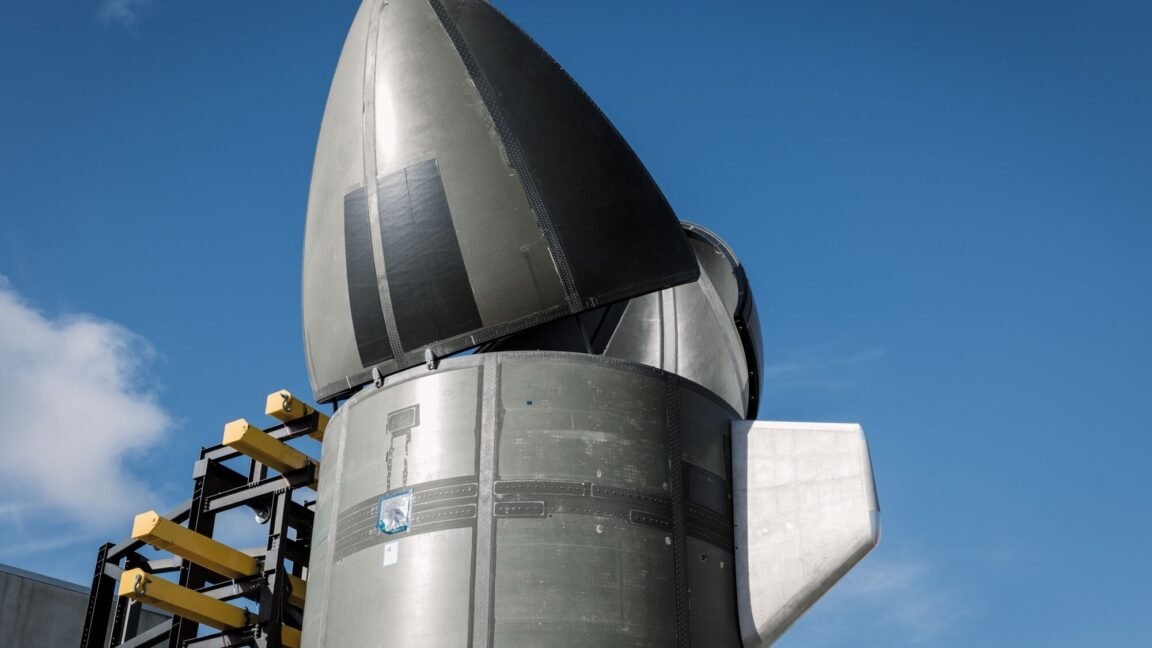
Welcome to Edition 8.31 of the Rocket Report! We have some late-breaking news this week with an update Thursday afternoon from Rocket Lab on the timing of its much-anticipated Neutron rocket. Following the failure of a first stage tank during testing, the company is pushing the medium-lift rocket’s debut into the fourth quarter of this year. Effectively that probably means 2027 for the booster, which is disappointing because we all very much want to see another reusable rocket take flight.
As always, we welcome reader submissions, and if you don’t want to miss an issue, please subscribe using the box below (the form will not appear on AMP-enabled versions of the site). Each report will include information on small-, medium-, and heavy-lift rockets as well as a quick look ahead at the next three launches on the calendar.

The ghost of Vector lives on. Tucson, Arizona-based satellite and rocket developer Phantom Space, co-founded by Jim Cantrell in 2019, has acquired the remnants of Vector Launch, Space News reports. The announcement is notable because Cantrell left Vector as its finances deteriorated in 2019. Cantrell said some of the assets, comprising flight-proven design elements, engineering data, and other technology originally developed for Vector, will be immediately integrated into Phantom’s Daytona vehicle architecture to reduce development risk.
What’s your vector, Victor? … “As the original architect of Vector’s vision, it’s deeply meaningful to bring these assets home to Phantom,” Cantrell said in a statement. “This acquisition isn’t just about technology, it’s about momentum. We’re accelerating Daytona, creating high-tech aerospace jobs in Tucson, and moving faster toward orbital capability.” The small-lift Daytona rocket could use some acceleration since it has been delayed year after year for a while now. At present, it is slated to debut during the second half of 2027.
UK limits launch liability. An amendment to the United Kingdom’s Space Industry Act will mandate that limits are set on how much launch operators are financially liable if something goes wrong, European Spaceflight reports. According to Sarah Madden, a space lawyer at the London-based law firm Winckworth Sherwood, the amendment to the legislation removes the risk that operators launching from the UK might face unlimited liability.
Putting policy into law … Although the legislation provided certainty, all three launch operator licenses issued to date by the UK Civil Aviation Authority include a cap on indemnity to the government. Virgin Orbit’s 2022 horizontal launch license capped this at $250 million, while the vertical launch licenses granted to Skyrora and Rocket Factory Augsburg in 2025 set the cap at £10.5 million ($14.2 million). However, these limits were imposed as a matter of policy rather than law.
PLD nabs launch contract. Spanish satellite operator Sateliot has signed a launch services agreement with PLD Space to launch its first two high-capacity 5G D2D (Direct-to-Device) Tritó satellites aboard a dedicated MIURA 5 mission, European Spaceflight reports. PLD Space is working toward the first flight of its 35.7-meter-tall MIURA 5 rocket in 2026. The rocket is designed to deliver payloads of up to 1,040 kilograms to low-Earth orbit and will initially launch from a new multi-user facility being built on the grounds of the Guiana Space Centre’s former Diamant launch complex.
Two at a time … PLD Space will attempt to carry its first two Tritó satellites to orbit aboard a dedicated MIURA 5 mission in 2027. According to the company, Sateliot selected PLD Space “based on MIURA 5’s ability to provide an independent, dedicated service tailored to the client’s specific needs, ensuring optimal launch conditions for deploying its space infrastructure.” Each Tritó satellite will have a mass of approximately 160 kilograms.

Neutron rocket launch slips to Q4 2026. As part of its quarterly earnings guidance update on Thursday, Rocket Lab provided a new launch target for the medium-lift Neutron rocket. Following the failure of first stage tank during testing, Neutron’s first launch is now targeted for “Q4 2026,” the company said. This is a notable slip, given that it was only last November that Rocket Lab announced a slip from the end of 2025 to “mid-2026.”
Invoking Berger’s Law … In its news release regarding the fourth quarter of 2025 earnings, the company said it completed successful qualification for Neutron’s thrust structure and entered the qualification phase for the interstage, and successfully qualified Neutron’s Hungry Hippo fairing and delivered it to the Assembly and Integration Complex in Virginia. I hate to do it, but I’m afraid that I am compelled to invoke Berger’s Law for rockets on this one, which states, “If a rocket is predicted to make its debut in Q4 of a calendar year, and that quarter is six or more months away, the launch will be delayed.” Since its inception in 2022, the law has been undefeated.
Falcon 9 extends its reuse milestone. SpaceX’s most-flown Falcon 9 rocket booster launched once again Saturday night, making its 33rd mission to space and back, Spaceflight Now reports. The 33rd flight of Falcon 9 booster 1067 came about two and a half months after its previous launch in early December. Its previous missions include four flights for NASA, the European Commission’s Galileo L13, and 20 batches of Starlink satellites.
Lordy, lordy, Falcon 9 is turning 40? … Nearly 8.5 minutes after liftoff, B1067 landed on the drone ship A Shortfall of Gravitas, positioned in the Atlantic Ocean. This was the 143rd landing on this vessel and the 575th booster landing to date for SpaceX. At present, SpaceX says it is working to certify its first stage of the Falcon 9 rocket for up to 40 flights.
Pentagon happy with military rockets. The Space Force officer tasked with overseeing more than $24 billion in research and development spending says the Pentagon is more interested in supporting startups building new space sensors and payloads than adding yet another rocket company to its portfolio, Ars reports. “We’re on path for mass-produced launch,” Maj. Gen. Stephen Purdy said at a space finance conference in Dallas.
Help needed to speed up payloads … Payloads, Purdy told Ars after his talk, are “the last frontier” for scaling space missions. “I remain convinced that we’re going to think about the mission that we need, and we’re going to need satellites out the door and launched and in orbit within the week, at scale,” Purdy said. “I’m very convinced that that’s the path that we’re going to move down on the commercial and government side.”
New data on how rockets pollute the atmosphere. New research bolsters growing concerns about the pollution produced by rocket launches, Ars reports. The new study in Nature analyzed a plume of pollution trailing part of a Falcon rocket that crashed through the upper atmosphere on February 19, 2025, after SpaceX lost control of its reentry. The authors said it is the first time debris from a specific spacecraft disintegration has been traced and measured in the near-space region about 80 to 110 kilometers above Earth. Changes there can affect the stratosphere, where ozone and climate processes operate. Until recent years, human activities had little impact on that region.
Studying the Ignorosphere … “I was surprised how big the event was, visually,” lead author Robin Wing, a researcher at the Leibniz Institute of Atmospheric Physics, said via email. He said people across northern Europe captured images of the burning debris, which was concentrated enough to enable high-resolution observations and to use atmospheric models to trace the lithium to its source. The study shows that instruments can detect rocket pollution “in the ‘Ignorosphere’ (upper atmosphere near space),” he wrote. “There is hope that we can get ahead of the problem and that we don’t run blind into a new era of emissions from space.”
Ambitious Chinese launch company moves into development. Chinese launch startup Space Epoch has secured B-round funding as the company moves toward a first orbital launch and recovery attempt late this year, Space News reports. The company says the funding means Space Epoch has entered a stage of large-scale development. “Three Yuanxingzhe-1 rockets already in production will undergo ground testing in the second half of the year, with the goal of achieving a successful first orbital launch and recovery by year’s end,” Space Epoch said in a statement.

Vulcan likely “many months” from flying again. Twice, once in 2024 and again earlier this month, United Launch Alliance’s Vulcan rocket experienced issues with the nozzle on one of its solid rocket boosters during a launch. In both cases, the rocket’s main engines compensated for the issues, but the US military is not eager to test Vulcan’s ability to overcome such a dramatic problem again, Ars reports. “Any time there’s an anomaly, my team is going to be actively engaged with the contractors to make sure we understand what happened and we correct that issue,” said Col. Eric Zarybnisky, program acquisition executive for Space Systems Command’s space access program.
A nettlesome nozzle issue … Zarybnisky spoke with reporters Wednesday in a roundtable at the Air Force and Space Force Association’s Warfare Symposium near Denver. He said it was too early to provide details on the direction of the investigation but predicted it would be a “many months process” to identify the “exact technical issue” and the corrective actions required to prevent it from happening again. After the first booster issue in 2024, investigators identified a manufacturing defect in a carbon composite insulator, or heat shield, inside the nozzle. The latest incident suggests the defect was not fixed or that there is a separate problem with Northrop’s boosters. (submitted by philip verdieck)
SLS rocket rolls back to hangar. NASA Administrator Jared Isaacman announced this week that a new problem with the Space Launch System rocket will require the removal of the rocket from its launch pad in Florida. The large booster, with the Orion spacecraft stacked on top, then rolled back to the Vehicle Assembly Building. The latest issue appeared on the evening of February 20, when data showed an interruption in helium flow into the upper stage of the Space Launch System rocket, Ars reports. NASA officials were eyeing a launch attempt for Artemis II as soon as March 6, the first of five launch opportunities available in March.
Marching into April … There are approximately five days per month that the mission can depart the Earth after accounting for the position of the Moon in its orbit, the flight’s trajectory, and thermal and lighting constraints. The next series of launch dates begins on April 1. The space agency bypassed launch opportunities earlier this month after a fueling test on the SLS rocket revealed a hydrogen leak. After replacing seals in the fuel line leading into the SLS core stage, NASA completed a second fueling test last week with no significant leaks, raising hopes the mission could take off next month. With the discovery of the helium issue last Friday night, the March launch dates are now off the table.
Next three launches
February 27: Falcon 9 | Starlink 6-108 | Cape Canaveral Space Force Station, Florida | 10:20 UTC
March 1: Alpha | Stairway to Seven | Vandenberg Space Force Base, California | 00:50 UTC
March 1: Falcon 9 | Starlink 17-23 | Vandenberg Space Force Base, California | 08:00 UTC