



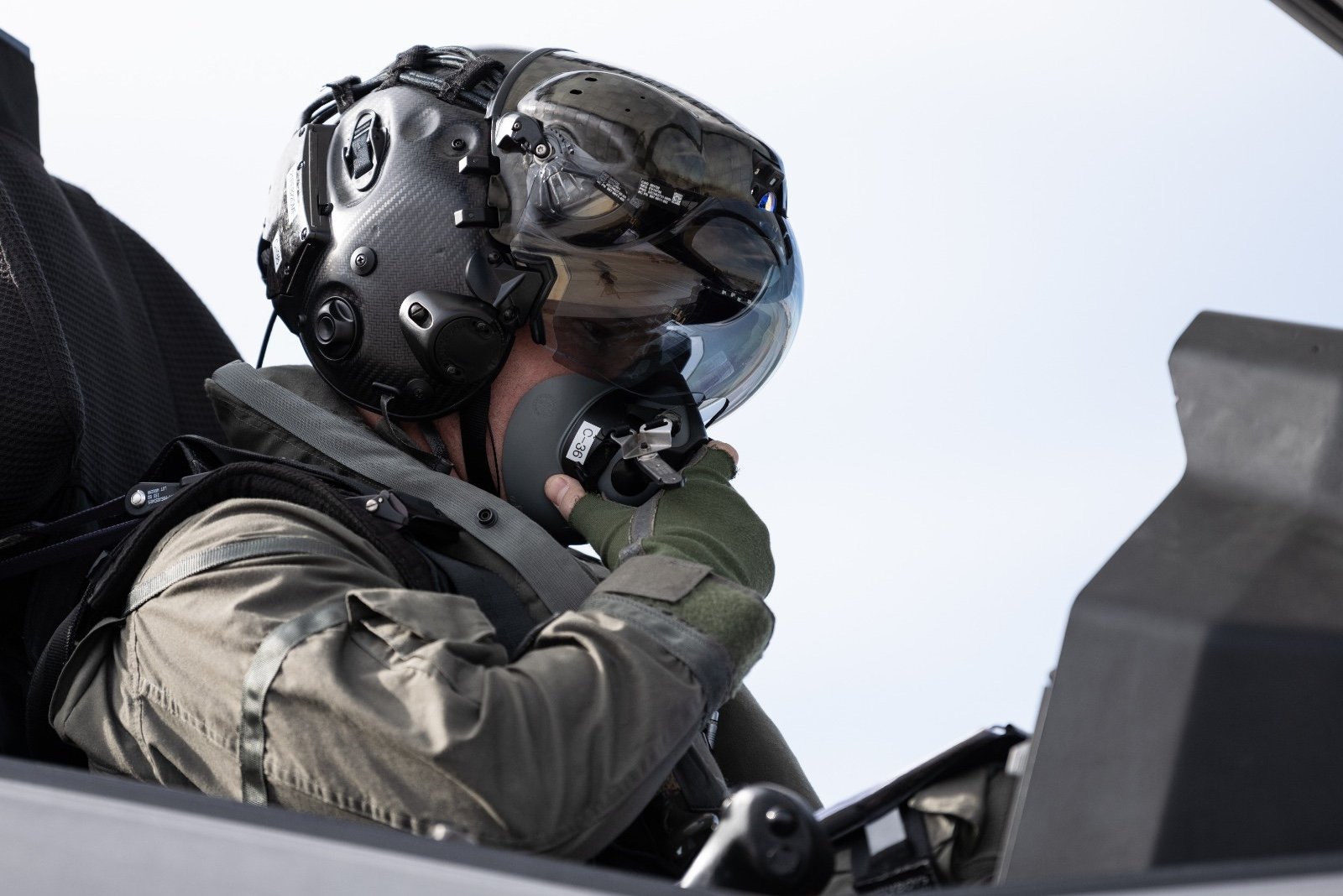
The arrest of a former US Air Force pilot for allegedly training Chinese military aviators exposes a widening shadow war over airpower expertise, where Western know-how has become as strategically contested as stealth jets themselves.
This month, the US Department of Justice reported that it had arrested former US Air Force pilot Gerald Eddie Brown Jr., 65, in Jeffersonville, Indiana, on charges of providing and conspiring to provide defense services to Chinese military pilots without authorization, in violation of the Arms Export Control Act.
Brown, a retired major who served more than 24 years in the Air Force and later worked as a contract simulator instructor on aircraft, including the F-35 and A-10, allegedly began arranging in August 2023 to train pilots from China’s People’s Liberation Army Air Force (PLAAF) without the required State Department license under US export control laws.
Prosecutors said Brown traveled to China in December 2023, where he fielded questions about US Air Force operations and presented a personal briefing before remaining there until returning to the US in early February 2026. Authorities said Brown coordinated through intermediaries, including Stephen Su Bin, a Chinese national previously convicted of hacking US defense contractors.
US officials described the case as part of a broader effort to prevent China from exploiting Western military expertise, warning that unauthorized training of foreign militaries threatens national security.
Brown’s case suggests that China’s recruitment of Western instructors is not episodic but structural — a response to persistent doctrinal, institutional and training weaknesses the PLAAF has yet to resolve domestically. His arrest fits a broader pattern. Recent reporting and government scrutiny in the UK and Germany — and press accounts elsewhere — have flagged efforts to recruit retired fighter pilots to train PLAAF aviators.
Financial incentives and limited post-service prospects make such contracts attractive. Many pilots retire relatively young, face reduced pensions and constrained commercial aviation pathways, lowering the threshold for accepting overseas training roles.
While most had not flown 5th-generation aircraft, they brought NATO-style mission planning and Composite Air Operations culture — precisely the cognitive framework China has struggled to institutionalize.
China’s growing fleet of 5th-generation fighter aircraft, such as the J-20 and J-35, may present unique training requirements that could not readily be provided by retired Western pilots who have flown older-generation aircraft.
As Chris Hubbard points out in a February 2023 article for Wild Blue Yonder, 5th-generation fighter training requires significantly greater pilot autonomy, advanced problem-solving against peer adversaries, and a higher baseline for what qualifies as “basic” proficiency.
Hubbard explains that aircraft such as the F-22 and F-35 employ all-aspect stealth, sensor fusion and autonomous sensor management, freeing pilots to focus on tactical and operational decisions rather than sensor control.
He adds that since 5th-generation fighter wingmen operate tens of miles — or dozens of kilometers — apart from each other, each pilot must make package-level decisions independently. He emphasizes that training must therefore emphasize mission-type orders, peer-level threat replication, growth-oriented debriefing, large-force integration and higher stress thresholds.
Yet hardware modernization has outpaced institutional adaptation. Atul Kumar argues in a July 2024 Observer Research Foundation (ORF) report that the PLAAF continues to struggle with weak pilot proficiency, limited combat experience and exclusion from Western exercises that refine advanced tactics. Kumar writes that training remains heavily scripted under strict “command control,” limiting pilot autonomy and constraining the mission-command flexibility required for complex stealth operations.
These institutional shortfalls are not confined to 5th-generation doctrine alone. As Brown also worked on simulators for the A-10 attack aircraft, his expertise may help address deficiencies in the PLAAF’s close air support (CAS) capabilities.
Kevin McCauley argues in an April 2022 T2COM G2 article that PLA CAS shortfalls are driven less by platform limitations and more by integration and employment faults; while J-10s can carry precision munitions, effective CAS requires specialist guidance teams and interoperable procedures.
Furthermore, Dennis Blasko writes in a recent article for the US Army Strategic Studies Institute (SSI) that PLA CAS remains institutionally immature, with tactics, techniques and procedures still evolving rather than standardized across the force.
He notes that no PLA-wide doctrine has been fully promulgated, leaving individual units to develop ad hoc solutions in coordination with nearby PLAAF brigades, and that the PLA Ground Force (PLAGF) has historically relied on organic artillery to substitute for air-delivered effects.
Even before pilots reach operational units, structural bottlenecks in flight academies slow modernization. Derek Solen writes in a November 2024 report for the China Aerospace Studies Institute (CASI) that structural and equipment-related deficiencies in PLAAF flight schools complicate preparation for fourth- and fifth-generation fighters.
Solen notes that until recently, training relied on outdated platforms such as the JJ-7 and JL-9 — derivatives of the MiG-21 — which were poorly suited to bridge students from basic trainers to modern fighters, and that transition training was long conducted in combat units rather than centralized academies, diffusing expertise and slowing modernization.
Solen adds that only with the introduction of the JL-10 — capable of approximating fourth-generation flight — has the PLAAF begun addressing gaps in advanced fighter preparation.
The Brown case ultimately highlights a deeper reality: China’s pursuit of Western instructors reflects not just ambition but dependency — an effort to import the doctrinal culture and operational judgment that cannot be rapidly engineered through aircraft procurement alone.