



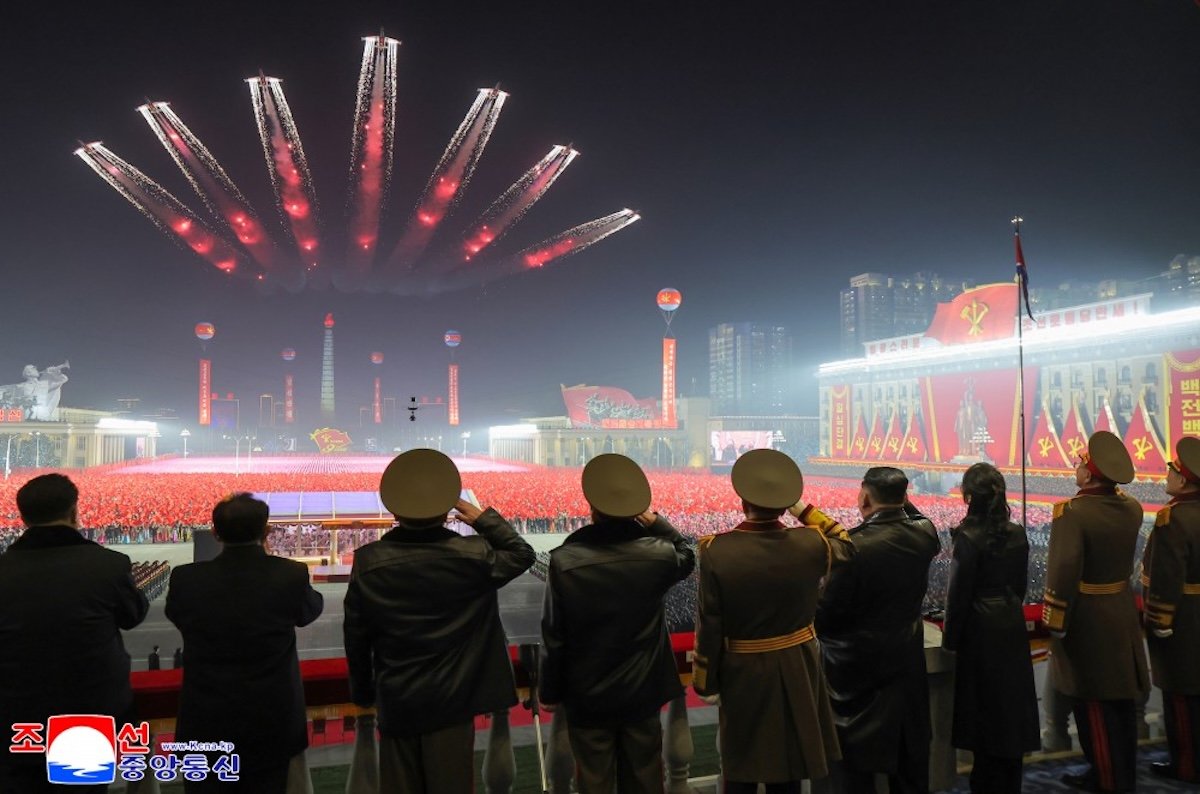
The Ninth Congress of North Korea’s ruling Workers’ Party covered ground this past week that was familiar from its last gathering five years ago. Kim Jong Un proclaimed his goals of state-driven economic development, a military buildup focused on nuclear weapons and his singular and unchallenged leadership.
Even the message to the United States was not new: Stop your “hostile” attitude and accept North Korea as a nuclear-armed state, and maybe we might be willing to talk to you.
The only surprise lay in Kim’s deep antagonism toward South Korea, making it clear that the demilitarized zone was no longer just a temporary demarcation line but now a wall of deep and unalterable division of the Korean Peninsula into two completely separate states.
This shift in North Korean policy away from the long-held aspiration to reunification was first expressed in late 2023 at a meeting of the nominal legislature, the Supreme People’s Assembly. At that time, Kim declared that the two Koreas were now belligerent states, and the South was an enemy against which even nuclear weapons could be used.
“That is in sharp contradiction with what our line of national reunification was: one nation [minjok], one state with two systems,” Kim said then, according to state media.
At that time, the shift was seen as being at least partly a response to conservative South Korean President Yoon Suk Yeol, who had staked out a tough, even provocative, stance toward North Korea.
But Kim Jong Un made clear at the latest party congress that this break applies as well, if not more so, to the government of Lee Jae Myung, which is more to the left.
Kim characterized the efforts of progressive South Korean administrations to engage, starting with Kim Dae-jung’s “Sunshine Policy,” as malicious subversion aimed at undermining and overthrowing his regime. “They have insidiously sought to spread their culture within us through opportunities for reconciliation and cooperation,” he told his loyal followers, “seeking to bring about change in some people through this, and furthermore, they have attempted to bring about the collapse of our system.”
North Korea “has absolutely no business dealings” with the “most hostile” South Korea, Kim opined, and will not consider them as “fellow countrymen.” Instead, “We will perpetuate the current situation in which all ties with South Korea have been completely eliminated, and we will not revive the misleading past under any circumstances.”
Kim paired this forceful declaration of permanent hostility with clear threats to use military force, including nuclear weapons, against their formerly brotherly Koreans. He claimed the right to use “the preemptive strike mission of deterrence,” and in other parts of his lengthy address, detailed the further development of their nuclear weapons capability for tactical use.
“If South Korea’s reckless actions at the doorstep of a nuclear power are deemed to be damaging to our security environment, we may initiate arbitrary action,” Kim said in a clear threat. And he made equally apparent that the goal of unification, this time at the point of a bayonet, had not been entirely abandoned.
“As an extension of that action,” Kim continued, “the possibility of South Korea’s complete collapse cannot be ruled out.”
Intensifying militarization
This fierce attitude toward South Korea was accompanied by an extended discussion of the growing militarization of North Korea and its economy.
Framed as a response to American and “imperialist” aggression, Kim laid out a program of continued modernization and buildup of the North’s Korean People’s Army (KPA), not only nuclear weapons but a range of conventional weapons, some of them being tested in Ukraine, where more than 10,000 North Korean forces have been deployed in combat.
Kim told the party congress that the regime will invest further in “nuclear trigger” capabilities – a crisis response system that will allow rapid use of nuclear weapons, including preemptive attack. All the measures are intended to ensure the survival of nuclear forces and the ability to retaliate in the event of an attack.
“This will include a more powerful ground- and underwater-launched intercontinental ballistic missile complex that integrates accumulated technologies, various artificial intelligence unmanned attack complexes, special assets for attacking enemy satellites in times of emergency, extremely powerful electronic warfare weapon systems for paralyzing enemy command centers and even more advanced reconnaissance satellites,” according to the leader.
Left unmentioned was the assistance that North Korea may be receiving from its strategic ally, Russia, in these modernization efforts. The work report submitted during the congress, and a shorter concluding statement, did not mention either Russia or China, North Korea’s treaty and economic allies. This may be due to the largely domestic audience for these events and the desire to assert North Korea’s self-reliance.
But at a military parade to conclude the party congress, Kim gave a place of honor to a rank of KPA soldiers who had fought in Ukraine. The unit was led by soldiers holding both North Korean and Russian flags.
In this militarized state, the KPA has a leading role in the pantheon of party and state. To some extent, this is a throwback to the “army first” policy laid down by Kim’s father, Kim Jong Il, in the mid-1990s. Kim Jong Un has not reverted to the idea that the military has primacy over the party or the state. But he made it clear at the party congress, and in a short speech at the military parade, that the army is not just a military force but also a key part of ideological and political control.
“The People’s Army must continue to reliably play the leading role of our great era as a revolutionary armed force loyal to the Party, as the core of national defense, as a pioneer of great changes, and as a creator of the people’s happiness,” Kim said at the parade.
Prospects for U.S.-North Korea engagement
These themes were the dominant messages of Kim’s work report and other statements. The reiteration of willingness to engage the United States has to be seen in this context, not as an open door to a return to a warm reunion with Donald Trump.
Kim offered a view of the international situation that mirrored the rhetoric and beliefs of his patrons in Beijing and Moscow:
“The world today is completely different from even five years ago, and international relations have entered a whirlwind of chaos and upheaval. The foundations of peace and security around the world are being seriously shaken by America’s hegemonic policies and tyranny, and armed conflicts are occurring one after another. The current international situation is moving in a more chaotic direction and is becoming more volatile and unpredictable as time passes.”
Kim laid responsibility for this “chaos” solely at the doorstep of Trump, accusing the president of disregarding “sovereignty, territorial integrity and security interests of other countries” under the “America First” banner.
US hostility toward North Korea is unchanged, the North Korean leader claimed at the party congress. But if the United States is ready to accept its status as a nuclear power and abandon all talk of denuclearization, “we have no reason not to get along.”
In response, a White House official told Yonhap News Agency that “President Trump remains open to talking with Kim Jong Un without any preconditions.”
Kim, however, is very much setting preconditions for talks. Rather than an opening, it is more accurate to read his words as an invitation to surrender to a North Korea that is an emergent nuclear-armed military power, positioned in a profoundly aggressive posture toward the United States’ ally South Korea.
At best, this party congress was an assertion of confidence by Kim in the rule of his family regime and a return to policies of isolation – this time, however, bolstered by a new alliance with its neighbors in Russia and China.
With “a people and an army that single-mindedly support the policies of the Party and the state, and a self-reliant economy with great development potential,” Kim concluded his address to the party congress, “there is no fortress that we cannot conquer and no great undertaking that we cannot accomplish.”
Daniel C. Sneider is a non-resident distinguished fellow at the Korea Economic Institute of America and a lecturer in East Asian Studies at Stanford University. This article, originally published by KEI, is republished with permission.