



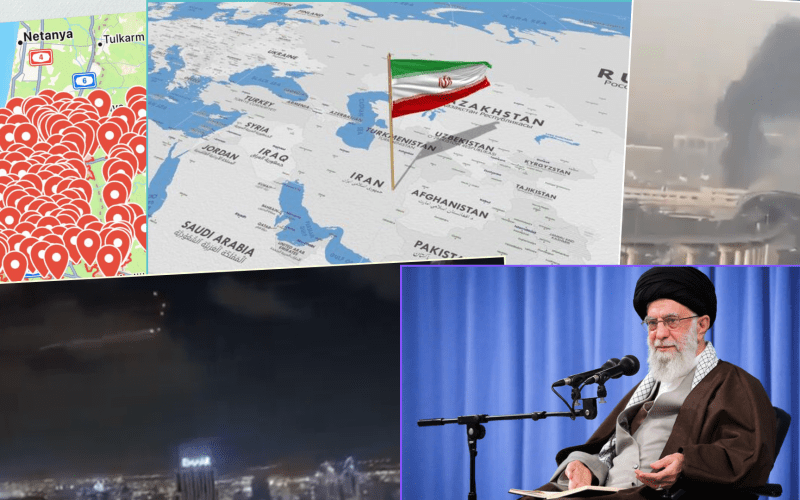
Israel said on Sunday it launched another wave of attacks on Iran, as Iranians grappled with uncertainty after the killing of their supreme leader in U.S. and Israeli strikes, while President Donald Trump warned of consequences for retaliation.
Hours after both nations said an air strike killed Ayatollah Ali Khamenei in the military campaign to overthrow the government of the Islamic Republic, its state media confirmed the 86-year-old leader’s death on Saturday.Loud blasts were heard in Dubai and the Qatari capital Doha for the second day on Sunday, witnesses said, as Iran’s retaliatory strikes on neighbouring Gulf states in response to U.S. and Israeli strikes on the Islamic Republic widened.
Iran had said it would target U.S. bases in the region but it has hit a range of other targets across Gulf cities.
A number of senior figures in Iran are known to have been killed in Saturday’s strikes on Iran.
They include:
- Ayatollah Ali Khamenei, Iran’s supreme leader, who was killed on Saturday morning at his office
- Iranian television reports that the country’s armed forces chief of staff Abdolrahim Mousavi was killed in airstrikes
- Tehran has also confirmed the death of the commander of the Revolutionary Guards, General Mohammad Pakpour
- State media has also reported that Khamenei’s daughter, son-in-law and grandchild were killed in the attack
- An intelligence source and military source has told CBS News that overall around 40 Iranian officials were killed in the strikes
Waves of blasts heard over Dubai, Doha
Two people were injured in Dubai after shrapnel from drones fell over two houses when they were intercepted, a Dubai Media office statement said.
Dubai’s international airport, its landmark Burj Al Arab hotel and posh man-made Palm Jumeirah Island all suffered damage.
Thick black plumes of smoke continued to rise from the Jebel Ali port area where one of the berths caught fire earlier on Sunday because of debris from an aerial interception of a missile.
Dubai is the biggest tourism and trade hub in the Middle East and its airport is one of the world’s busiest travel hubs.
Qatar’s interior ministry said on Sunday it was responding to a limited fire in an industrial zone after debris fell from an intercepted missile.
Trump said the air strikes aimed to end a decades-long threat from Iran and ensure it could not develop a nuclear weapon.
He sought to justify a risky gambit that seemed to contradict his professed opposition to American involvement in complex overseas conflicts.
“This is not only Justice for the people of Iran, but for all Great Americans, and those people from many Countries throughout the World, that have been killed or mutilated by Khamenei and his gang of bloodthirsty THUGS,” Trump wrote on Truth Social.
Trump and Netanyahu told Iranians to pursue a rare chance to topple their clerical leaders.
LEADERS ALREADY FACED PRESSURE ON SEVERAL FRONTS
The leadership had already been under pressure from an economy hammered by sanctions, protesters who proved ready again to take to the streets despite fierce crackdowns and regional proxies severely weakened by Israeli attacks.
Israel and the United States timed the attacks to coincide with a meeting of Khamenei and his top aides, said two U.S. sources and a U.S. official familiar with the matter.
Khamenei was working in his office at the time of Saturday’s attack, state media said. It also killed his daughter, grandchild, daughter-in-law and son-in-law.
Experts said that while the deaths of Khamenei and other Iranian leaders would deal the country a major blow, it would not necessarily spell the end of Iran’s entrenched clerical rule or the sway of the elite Islamic Revolutionary Guards Corps over the population.
Trump evoked the 1979 storming of the U.S. embassy in Tehran, when Iranian student activists in coordination with radical clerics took 52 American hostage for 444 days, demanding the extradition of the deposed Shah from the United States.
Israel’s military said it targeted Iran’s ballistic missile and air defense systems with strikes on Sunday morning.
Iran’s armed forces would soon retaliate again with their biggest offensive against U.S. bases and Israel, the Revolutionary Guards vowed in a statement on Sunday.
Iran responded to Saturday’s initial attacks by launching hundreds of missiles and drones targeting U.S. troops and cities in Israel and Arab countries allied with Washington, prompting widespread cancellations of Middle East flights.
The Pentagon said there were no U.S. deaths or injuries.
ONE OF GLOBAL AVIATION’S WORST DISRUPTIONS
Major Middle Eastern airports, including Dubai, the world’s busiest international travel hub, were shut on Saturday after Iran’s missile retaliation unleashed one of global aviation’s most severe disruptions in years.
Dubai’s landmark Burj Al Arab hotel and the airport, which handles more than 1,000 flights a day, were damaged in an overnight attack on sites across the Arab Gulf states that also hit airports in Abu Dhabi and Kuwait.
On Saturday, Tehran warned that it had closed the Strait of Hormuz, the narrow conduit for about a fifth of global oil consumption, raising expectations of a sharp jump in oil prices.
The OPEC+ grouping of major oil producers is set to meet on Sunday and may consider a larger-than-planned output increase as several tanker owners, oil majors and trading houses suspended energy shipments through the Strait.
After Israel pounded Iran in a 12-day air war in June, joined by the United States, both warned they would strike again if Tehran persisted with nuclear and ballistic missile programs.