



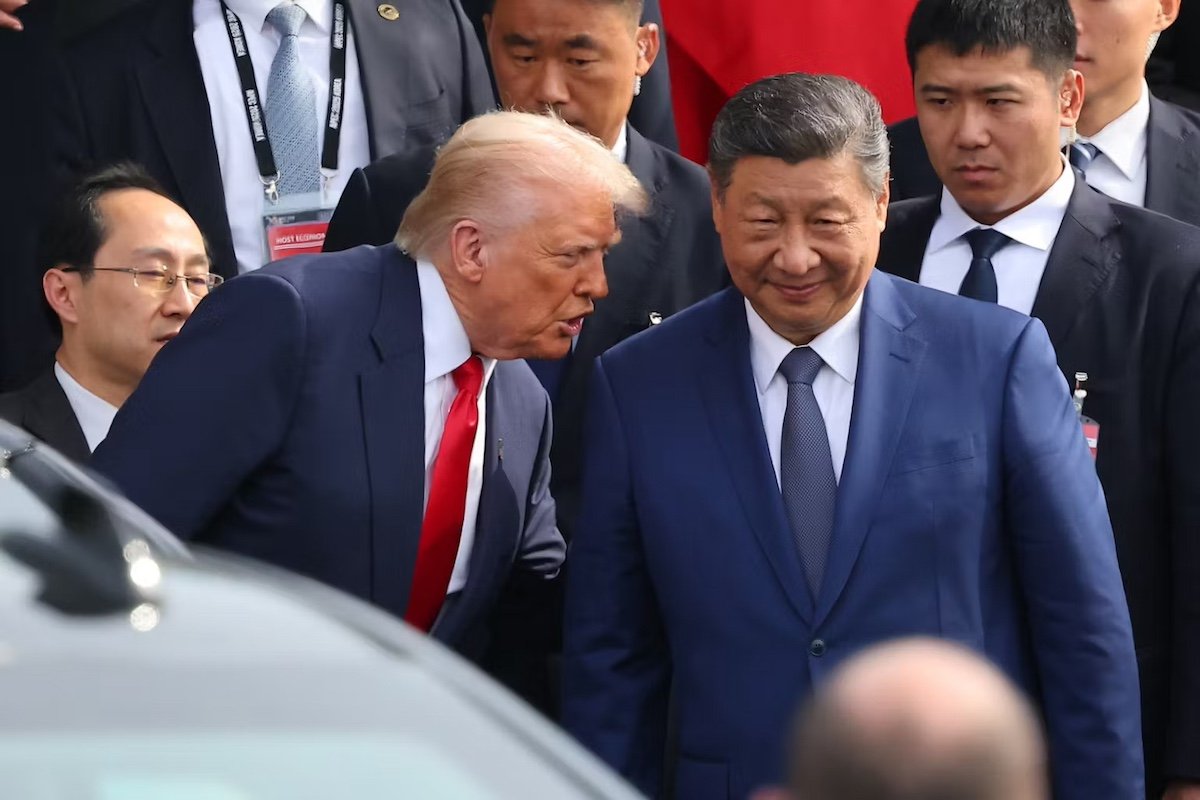
TOKYO — Donald Trump’s planned visit to Beijing next month, the first by a US president since 2017, is losing significance by the day.
Ten days ago, high drama surrounded Trump’s March 31-April 2 trip. Chinese leader Xi Jinping, after all, has been stringing along the Trump 2.0 White House since April 2025, winning trade-negotiation delays after delays. Beijing was Trump’s chance for an art-of-the-deal victory.
Now that the Supreme Court has clipped Trump’s wings, ruling his tariffs illegal, Trump’s tete-a-tete appears more pomp than circumstance. In fact, one could almost see Trump World angling to scrap the trip altogether — opting to wait until Xi’s planned trip to Washington later this year to enjoy a home-field advantage.
Though he’s frantically trying to save face — pivoting to a 10% to 15% universal tariff — the top US court effectively disarmed the trade war weapon Trump had wielded over friends and foes alike.
“The decision narrows unilateral presidential trade powers, constrains improvisational coercion, and shifts the terrain of US-China competition away from executive brinkmanship to institutional process,” says Zongyuan Zoe Liu, a geopolitical analyst at the Council on Foreign Relations.
Liu notes that when the Supreme Court ruled that the International Emergency Economic Powers Act (IEEPA) doesn’t authorize tariffs, “it more than invalidated President Donald Trump’s favored tariff authority. The ruling triggered the need to rapidly rewrite the White House’s economic statecraft playbook.”
The bottom line, Liu says, this paradox will define the next phase of US-China relations. Though the US retains formidable tools of pressure, deploying them will require more consensus, more procedure, and more time.
“Thus, the Court’s decision doesn’t end tariff confrontation — it professionalizes it,” Liu says. “Economic conflict between the world’s two largest economies will continue, but it will proceed less like an improvised duel and more like a regulated contest, shaped as much by legal architecture as by political will.”
Patience and policy minutiae are not Trump’s strong suits, which gives China an advantage. The tariff landscape just got “a lot more complicated,” notes Payne Griffin, a former senior official at the US Trade Representative (USTR) office.
For example, Trump’s pivot from IEEPA to basing tariffs on Section 301 of the US trade code “has a lot more processes and guardrails around it, there is more transparency built into the statute, and there are opportunities for stakeholders to comment, to give testimony at public hearings,” Ed Brzytwa, vice-president of international trade at the Consumer Technology Association, tells the Retail Banker International news site.
At the moment, Trump is leaning on Section 201 to impose a universal tariff. This is scrambling Trump’s trade war in curious ways.
In Southeast Asia, notes Mira Rapp-Hooper at the Brookings Institution, “previous deals and framework arrangements clustered around 19%, meaning these partners do relatively better under President Trump’s new Section 122 tariffs than they did previously.”
Rapp-Hooper adds that “the biggest open questions in Asia are likely to face those partners whose negotiations are not yet settled — India, where a significant and robust trade deal was delayed for many months by a leader-level downturn in relations, and Vietnam, where a near-deal was scuttled in July and a replacement has been elusive. And of course, China’s overall tariff rates come down under the ruling, which saps some of President Trump’s leverage ahead of his visit.”
Xi also knows Trump needs a trade deal more than China. A recent ABC News/IPSOS poll found at 64% of Americans disapprove of Trump’s tariffs.
As Dan Anthony, executive director of the We Pay the Tariffs group representing small businesses, puts it: “The polls all tell the same story: voters really dislike tariffs and the high prices they cause. As the administration doubles down on tariffs despite the Supreme Court decision, it’s up to Congress to push back. We’re sharing these polls with all congressional offices ahead of the midterms because they will be judged on the response to these deeply unpopular policies, not the president.”
Trump’s deepening unpopularity will play to Xi’s benefit. Estimates are that the tariffs cost each US family around US$1,700 in 2025. Illinois Governor JB Pritzker sent an invoice to Trump demanding a refund of that exact amount for every household in his state.
The optics are that China is posting a record US$1.2 trillion trade surplus, despite the tariffs, which are also bad for Trump World. China knows, in other words, that time is on its side as Trump grows increasingly desperate for a deal.
Only a big, beautiful China agreement might enable Trump to convince the #MAGA faithful that tariff-driven inflation, extreme market volatility and employment losses were all worth it. Without one, his poll numbers could continue to collapse.
This raises the odds of a US-China free-trade deal in name only. Not the “grand bargain” of Trump’s dreams that advantages the US, but a face-saving pact that enables the White House to claim a win. That is probably just fine with Xi, who will get high-fives in Beijing for giving up very little to Trump.
After all, “Trump remains determined to use trade tariffs to advance strategic objectives that have little or nothing to do with trade,” economist Nancy Qian at Northwestern University.
Case in point: how Trump “has broken with decades of free-trade orthodoxy, threatening to impose tariffs not only on strategic adversaries like China but also on longstanding allies like Canada and Mexico. Even Denmark —a NATO member and steadfast US ally during and after the Cold War — has found itself in Trump’s crosshairs.”
Here, Taiwan is also a wildcard. Xi told Trump on a phone call earlier this month that the island is the “most important issue” variable in Sino-US relations. For Xi’s party, its claims to Taiwan loom larger than trade, including Chinese purchases of US agricultural products and American energy.
As Minxin Pei at Claremont McKenna College, tells Bloomberg: Xi might be “open to giving Trump a better commercial deal” in exchange for a pro-China statement on Taiwan.
Another reason Trump is losing leverage ahead of Beijing’s trip is that Xi has outmaneuvered this White House at every turn. Trump’s tariffs, for example, has many of Washington’s biggest allies viewing China as a more reliable economic partner.
Last month, Keir Starmer was in Beijing, the first visit by a UK prime minister since 2018. That was hot on the heels of Mark Carney, the first trip to China by a Canadian prime minister since 2017, and more recently Chancellor Friedrich Merz of Germany. The leaders of Finland, France, Ireland, South Korea and myriad other top economies recently are a beeline to China for Xi meetings.
Trump has been none too happy about the “sell America” narrative coinciding with this “pivot to China” dynamic. He quickly threatened Canada with a 100% tariff if it didn’t abandon its trade dealings with China. Trump also recently threatened higher tariffs on the staunch American ally South Korea.
It seems no coincidence that the European Union and India picked now to sign a trade deal nearly two decades in the making. That was just two weeks after the EU concluded a deal with South America’s Mercosur bloc — which includes Brazil and Argentina — after 25 years of talks.
“The US’s retreat from the global economy is likely to make America less influential, less resilient, less secure, and poorer over the long term, as economic integration deepens elsewhere and other governments set new standards in trade agreements,” notes economist Scott Lincicome at the Cato Institute think tank. He adds that “America’s departure from the epicenter of global trade began years ago and has accelerated in recent months.”
According to the World Trade Organization, Lincicomeadds, the US share of global merchandise trade (imports plus exports) in the third quarter was the lowest for that period of the year since 2014, and the drop from 2024 was larger than the cumulative loss between 2015 and 2024.
The Boston Consulting Group projects that the trend will continue, lowering the US’s share of world trade from 12% in 2024 to 9% by 2034, due to “policies pursued by the Trump administration.”
Timing matters, of course. Former Goldman Sachs economist notes that the Supreme Court’s decision “coincides with a period of notable wobbles in the artificial intelligence equity market excitement story.
US economic data, including the real GDP data for the second half of 2025, make abundantly clear that there has been a major rise in domestic investment spending driven by those at the center of the AI boom, with a clear weaker trend in employment and, with this, some softening of the consumer.”
O’Neill, who’s now with the Chicago Council on Global Affairs, adds that “while this mathematically translates into stronger productivity and indeed could sustain real gains in productivity, if the new mood of the stock market persists, it is very likely that investment spending will start to slow. Such an outcome would make the Trump administration’s underlying lack of a cohesive economic strategy even more apparent.”
Never mind the credit market dynamics that have some on Wall Street warning of echoes of the 2007-2008 subprime crisis.
As JPMorgan Chief Executive Officer Jamie Dimon told investors this week: “Unfortunately, we did see this in ’05, ’06 and ’07, almost the same thing — the rising tide was lifting all boats, everyone was making a lot of money.”
Though he said JPMorgan isn’t making riskier loans to boost net interest income (NII), “I see a couple of people doing some dumb things. They’re just doing dumb things to create NII.”
That the US national debt is racing toward the US$39 trillion mark hardly helps. China is the No. 2 holder of US Treasury securities after Japan. That gives Team Xi $683 billion of potential leverage at a moment when the Court has effectively tied one arm behind Trump’s back in trade talks.
This makes this upcoming China visit more about dread than triumph for Trump World.
Follow William Pesek on X at @WilliamPesek