



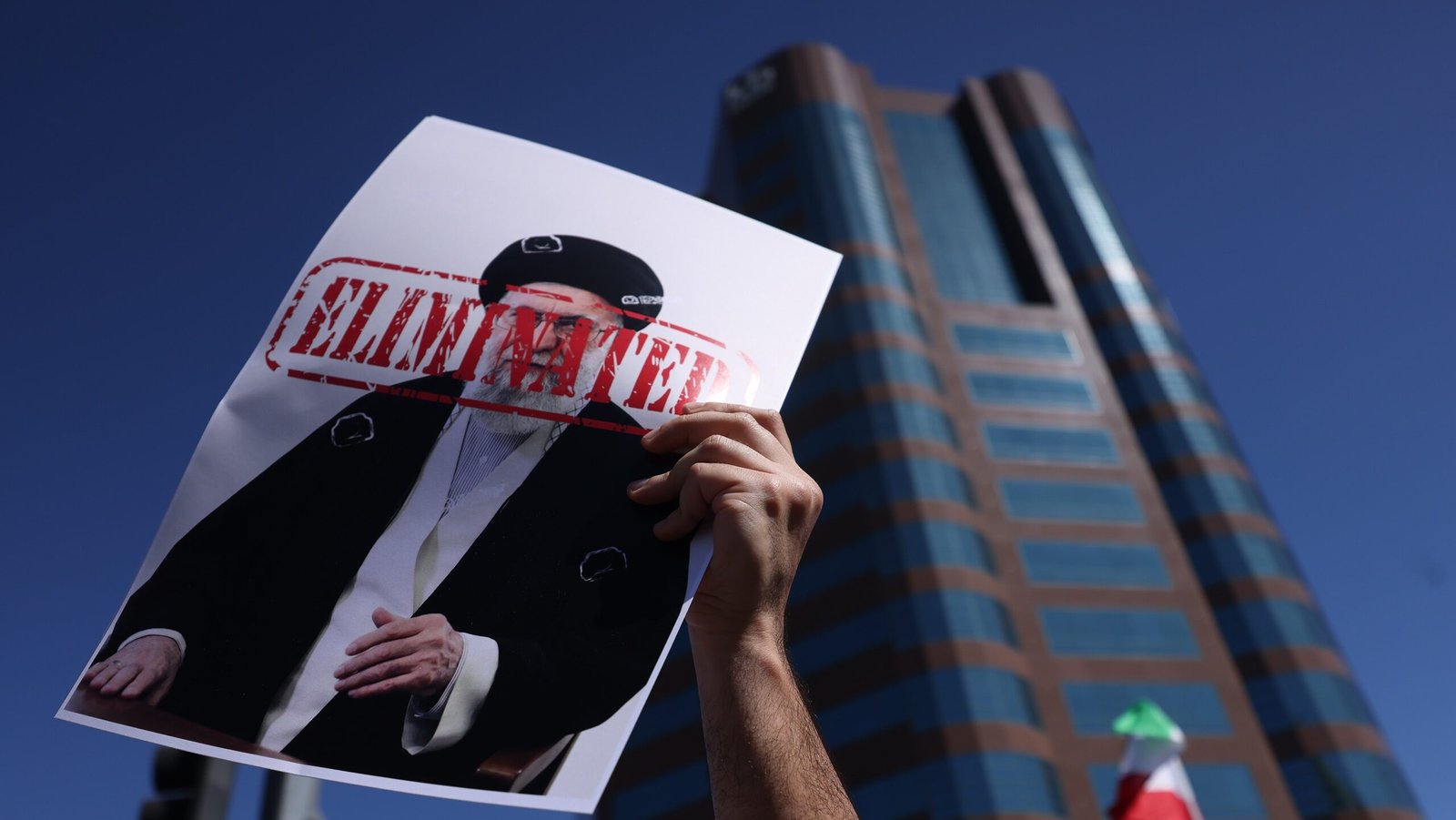
Leadership targets across Iran are hit in coordinated air operations while missile retaliation spreads across Israel and the Gulf
Iran’s Supreme Leader Ayatollah Ali Khamenei and an estimated 40 senior figures in Iran’s leadership have been reported killed in a massive joint military operation launched by the United States and Israel, officials said Saturday, Feb. 28, in what represents an extraordinary escalation of the conflict that erupted earlier in the day. As reports circulated into the night that Khamenei may have been killed, videos and accounts from Tehran and other Iranian cities showed residents chanting slogans against Khamenei and the Islamic Republic from rooftops, with loud music heard in some neighborhoods and scenes of celebration shared widely on social media.
Cheering in Tehran as word spreads of the death of the country’s authoritarian supreme leader, Ayatollah Ali Khamenei, Feb. 28, 2026. (Social media)
Among the senior figures reported killed were Defense Minister Aziz Nasirzadeh and Islamic Revolutionary Guard Corps (IRGC) commander Mohammad Pakpour, according to multiple reports. Separate reporting also said Ali Shamkhani, a senior adviser to the supreme leader and a key figure tied to Iran’s security establishment, was killed in the attacks.
The people that make all the decisions, most of them are gone
Israeli Prime Minister Benjamin Netanyahu said there were “many signs that [the supreme leader] is no longer alive,” and earlier reports from Israeli military sources indicated that Khamenei’s fortified compound in Tehran was hit during the opening phase of the assault. President Donald Trump told US media that “we feel certain” Khamenei was killed along with most of Iran’s senior leadership, adding, “The people that make all the decisions, most of them are gone.” Iran did not immediately confirm the death reports, and state media issued conflicting messages over the course of the day, leaving parts of the picture unsettled even as Israeli and US officials spoke with growing certainty.
As speculation about Khamenei’s fate intensified, the head of public relations at Khamenei’s office issued a statement warning of “psychological warfare.” Iranian officials also confirmed that some members of Khamenei’s family were killed at the leader’s compound, including his daughter-in-law and son-in-law, according to reports circulating in Iranian media and opposition channels. Iranian state television did not immediately confirm those reports, and the Islamic Republic of Iran Broadcasting News Network—whose broadcasts were reported to be disrupted—did not address claims about Khamenei’s family members or the reported killing of senior commanders.
The operation, named by Washington “Epic Fury” and by Jerusalem “Roaring Lion,” began early Saturday morning across multiple Iranian provinces, with explosions reported in Tehran and other cities including Isfahan and Tabriz. Telecommunications networks were severely disrupted in Tehran, and a near-total internet blackout was reported, impairing independent confirmation of damage and casualties inside Iran.
Israeli defense officials said their air force took part in the largest aerial operation in its history, striking hundreds of targets across Iran’s military and defense infrastructure. According to Israeli military sources, the Israeli Air Force deployed approximately 200 fighter aircraft to carry out strikes on more than 500 military objectives, including air-defense systems, ballistic missile launchers, command centers, and sites associated with Iran’s nuclear and strategic weapons programs.
The United States also conducted its own series of sorties using aircraft and naval assets positioned throughout the Middle East, with military officials saying “dozens” of US strikes were carried out from bases and carrier groups in the region. A US military spokesman emphasized that the campaign was “not a small strike” and that an effort was made to combine air and sea firepower against coordinated targets to degrade Iran’s ability to sustain offensive operations.
Iran’s retaliation was swift and wide in scope. Within hours of the initial air attacks, Iran’s Revolutionary Guard Corps announced the launch of waves of ballistic missiles and drones toward Israel and at least six other countries that host US military bases and facilities, including Kuwait, Bahrain, Qatar, Saudi Arabia, and the United Arab Emirates. Iranian state military communications declared that all “occupied territories and the criminal US bases in the region” were legitimate targets.
In Israel, repeated air-raid sirens sounded in central and northern cities throughout the afternoon and evening as defensive systems worked to intercept incoming Iranian ballistic missiles and drones. Civil defense authorities moved quickly, ordering the closure of schools and workplaces nationwide and advising civilians to remain in fortified safe spaces as alerts continued through the evening.
Israeli emergency services reported dozens of lightly injured civilians, with Magen David Adom, the national rescue organization, saying that 89 people were treated for minor injuries tied to the waves of Iranian missile and drone attacks. Many of these injuries occurred when residents were moving to shelters or as a result of shattered glass from distant explosions and interceptions.
Despite the intensity of Iranian launches, senior Israeli military officials said no major strategic military facilities inside Israel were destroyed, though debris and shock waves were evident in multiple locations. Reports cited debris and impact sites in areas including Jerusalem, Beit Shemesh, and other parts of central Israel—in many cases linked to intercepted Iranian fire rather than direct hits.
Iran’s retaliation has also left its mark across the Gulf. In Kuwait, a drone targeted Terminal 1 at Kuwait International Airport, injuring several airport workers and causing limited damage. Bahrain confirmed that a missile struck a US Navy 5th Fleet support facility, describing it as “a blatant violation” of sovereignty, while the United Arab Emirates reported at least one civilian death in Abu Dhabi from falling debris after Iranian missiles were intercepted in the capital’s airspace.
Commercial aviation in the region has been heavily disrupted. Airlines canceled or rerouted flights due to the closure or restriction of airspace over Israel, Iran, Iraq, and Gulf states, with carriers such as Emirates, Qatar Airways, and regional carriers diverting long-haul flights to avoid potential missile corridors.
Inside Iran, the conflict has rapidly affected daily life and infrastructure. Hospitals were placed on high alert as explosions were reported across multiple provinces and smoke plumes were visible over Tehran. Reports of disrupted communications and restricted internet access have limited independent coverage, and state media broadcast selected images of damage and rescue efforts in targeted areas.
Iran’s official news agency, IRNA, reported that more than 120 civilians were killed in US and Israeli airstrikes on Iran, a figure that could not be independently verified due to the communications blackout and restrictions on access. Ali Larijani, secretary of the Supreme National Security Council, warned that Iran would carry out extensive missile and drone attacks to make the United States and Israel “regret” striking the Iranian government.
One of the most widely reported and tragic incidents was an alleged strike on the Shajareh Tayyebeh all-girls primary school in Minab, in southern Iran’s Hormozgan province. Iranian authorities said the strike occurred at about 10:45 a.m. local time, with initial reports claiming more than 40 killed and later figures climbing substantially. Those casualty numbers have not been independently verified, and outside confirmation has been limited by access constraints and communications disruption inside Iran. Iranian officials denounced the incident as a “savage act” and a “war crime.”
Even as Tehran sought to manage public anger, riot police units were reported deployed in parts of the capital, including the north and east, as Israeli and US fighter jet activity and strikes on military targets in and around Tehran continued into the evening. At the same time, Iranian outlets close to the IRGC denied that Khamenei had been killed, and Tasnim News Agency quoted a source in Khamenei’s office rejecting reports of his death.
The public mood in Tehran nevertheless appeared volatile and, in pockets, celebratory. Videos widely circulated online showed people chanting against the regime and celebrating in the streets and from homes, while many Iranians appeared to be waiting for official confirmation about Khamenei’s fate. Under The Media Line’s reporting guidelines, accounts from private individuals about street celebrations cannot be quoted directly, but multiple videos and public posts shared across social platforms pointed to celebrations and anti-regime chants in several neighborhoods.
International reaction to the crisis was swift and tense, with leaders and diplomats around the world calling for restraint and warning of the broader consequences of a widening war. United Nations Secretary-General António Guterres condemned the military escalation, urging all parties to cease hostilities and reengage in diplomatic talks while warning of “grave humanitarian consequences” if the conflict spread further. Western capitals emphasized concern for civilian safety and called for immediate restraint, even as officials in Washington and Jerusalem defended the operation as necessary to protect national security.
The reported killing of Khamenei—one of the world’s longest-serving authoritarian leaders, in power since 1989—raises immediate questions about succession in Iran’s theocratic system and the durability of command and control as the strikes continue. With no publicly designated successor and powerful security institutions poised to shape any transition, analysts expect a volatile internal contest even as Iran continues to fire outward.
This extraordinary escalation—the most significant state-to-state conflict involving Iran in decades—has revealed sharp divisions within Iranian society and reshaped geopolitical alignments across the Middle East. For years, Iran has faced internal unrest, including high-casualty demonstrations and protests earlier in 2025 and 2026 that drew international attention and criticism of the regime’s human-rights practices. Many Iranians hope that Saturday’s events will bring a decisive shift in governance, even as the human cost of the fighting and the danger of further escalation remain unknown.
The situation remained highly fluid late Saturday. US and Israeli officials indicated that additional operations could continue, describing the strikes as part of broader efforts to dismantle Iran’s missile and nuclear-related capabilities. Iran has vowed continued retaliation, with commanders and state-linked messaging warning that further waves of missiles and drones could follow and that US and Israeli assets in the region would remain targets. Regional powers and global institutions have urged restraint, but the trajectory of the conflict remains uncertain, and the immediate future could see both intensified hostilities and diplomatic pressure to avert a wider conflagration.